How to Invest in Silver in India: Opportunities, Risks and the Right Portfolio Strategy
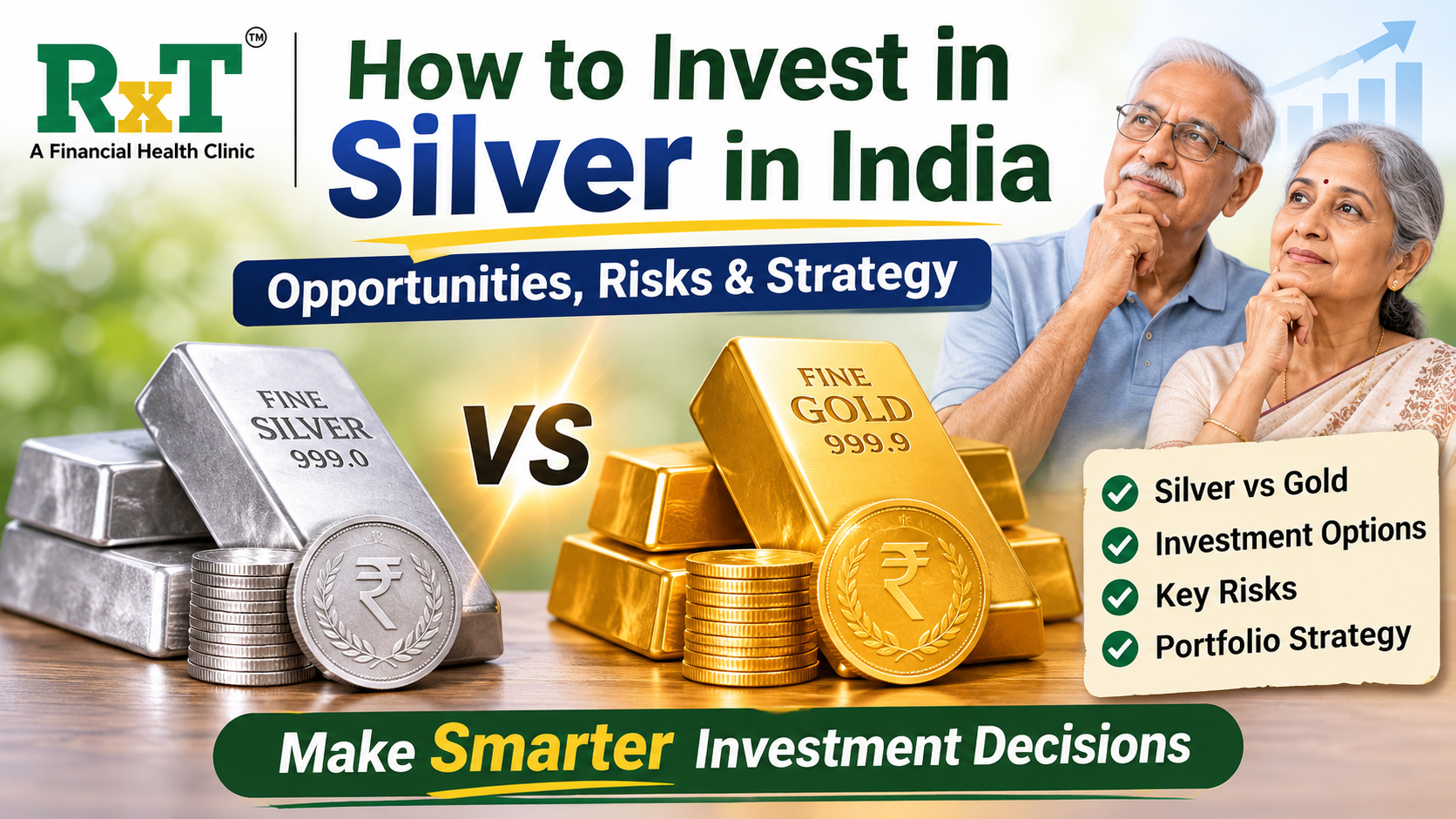
How to Invest in Silver in India: Opportunities, Risks and the Right Portfolio Strategy
Is silver a good investment? Why are silver prices rising, what drives industrial demand, and how can investors gain exposure to silver without taking unnecessary risks?
Silver is more than a precious metal used in jewellery and ornaments. It is also an important industrial commodity used in electrical and electronic applications, solar technology, automotive components and several other industries.
This dual role makes silver different from gold as an investment asset.
However, silver is also considerably volatile. Its price can be influenced by industrial demand, global economic conditions, mining supply, investor sentiment, currency movements and movements in the broader precious-metals market.
The short answer: Silver can have a place in a diversified investment portfolio, but it should generally be treated as a carefully evaluated allocation rather than a substitute for core investments such as equity, debt and other financial assets.
At RxT – A Financial Health Clinic, we believe that the decision to invest should begin with understanding the investor's financial situation, objectives, risk capacity and existing portfolio.
The important question is not simply whether silver prices will rise. It is whether an investment in silver is appropriate for your financial health.
1. Why Is Silver an Important Investment Asset?
Silver has two distinct roles in the global economy.
A. Silver as a precious metal
Silver has traditionally been used for:
Jewellery and ornaments
Coins and bullion
Collectibles
Precious-metal investments
Like gold, silver is traded internationally and its price is influenced by global market conditions, currency movements, inflation expectations and investor demand.
However, silver should not automatically be considered a safe-haven asset in the same way as gold. Its industrial exposure and greater price volatility can produce very different market behaviour.
B. Silver as an industrial commodity
An important characteristic of silver is its industrial usefulness.
Silver is valued for its electrical conductivity and other physical properties. It is used in several industrial applications, including:
Solar photovoltaic technology
Electrical and electronic components
Automotive and automotive-electronics applications
Industrial equipment
Medical applications
Certain specialised defence and aerospace applications
This industrial demand gives silver an additional price driver that gold does not share to the same extent.
The Silver Institute's World Silver Survey 2026 reports that global industrial silver demand reached approximately 657.4 million ounces in 2025, representing a substantial part of total silver demand.
However, industrial demand declined by 3% during 2025. In particular, improvements in solar-cell manufacturing efficiency and substitution reduced silver consumption in photovoltaic applications.
This is an important distinction: technological development can increase the number of applications using silver, but manufacturers can also reduce the amount of silver required per application.
Therefore, industrial growth does not automatically translate into continuously rising silver prices.
The RxT perspective: Understanding the actual demand and supply dynamics is more important than simply assuming that every new technology will increase silver prices.
2. What Drives Silver Prices?
Silver prices are influenced by several interconnected factors.
A. Industrial demand
Industrial demand is one of the major factors that distinguishes silver from gold.
When industrial activity expands, demand for silver-containing components and applications may increase.
Developments in solar energy, electronics, automotive technology, power infrastructure and other industries can influence silver consumption.
On the other hand, when industrial production slows, demand may weaken.
For example, an economic slowdown could affect industrial orders, manufacturing activity and investment in new infrastructure.
This can create downward pressure on silver demand.
B. Mining supply
Silver supply is another important consideration.
Mining production does not always respond immediately to changes in silver prices or demand.
A significant portion of silver production is associated with mining operations that primarily target other metals. Consequently, silver supply can also be influenced by developments in those mining industries.
If demand grows faster than available supply, market conditions may become tighter.
However, a supply deficit does not guarantee that prices will rise. Inventories, investment flows, recycling, currency movements and market expectations also matter.
C. Global economic conditions
Silver has an important industrial component.
Therefore, global economic activity can influence its price.
A slowdown in manufacturing or industrial investment may reduce demand.
Conversely, stronger economic activity and expansion in certain technology and infrastructure sectors may support consumption.
This makes silver particularly sensitive to changes in the global economic outlook.
D. Gold prices and precious-metal sentiment
Silver often moves in the same broad direction as gold, although the relationship is not constant.
When investors become more interested in precious metals, both assets may benefit.
However, silver can experience sharper price movements because of its additional industrial exposure and different market structure.
Consequently, investors should not assume that silver will always follow gold or deliver the same type of portfolio protection.
E. Currency and interest-rate movements
Silver is internationally priced, generally in US dollars.
For Indian investors, movements in the rupee against the US dollar can influence domestic silver prices.
Changes in interest rates, inflation expectations and global financial-market conditions can also affect investor demand for precious metals.
This means Indian silver investors are exposed to more than just the international silver price.
3. Gold vs Silver: What Is the Difference?
Gold and silver are both precious metals, but they perform different economic roles.
Parameter | Gold | Silver |
|---|---|---|
Primary role | Precious metal and monetary reserve asset | Precious metal and industrial commodity |
Industrial usage | Relatively limited compared with silver | Significant industrial applications |
Industrial-demand sensitivity | Lower | Higher |
Price volatility | Generally lower than silver | Generally higher |
Central-bank demand | Important source of demand | Not comparable to gold |
Investment behaviour | Often viewed as a defensive asset | Influenced by both precious-metal and industrial cycles |
Portfolio role | Potential diversification and defensive allocation | Potential commodity exposure with higher volatility |
Gold is often viewed as a safe-haven asset, particularly during periods of financial uncertainty and geopolitical tension.
Silver has a different risk profile.
Its industrial applications can create opportunities during periods of technological and economic expansion. However, industrial exposure can also become a disadvantage when economic activity weakens.
What is the Gold-Silver Ratio?
The Gold-Silver Ratio indicates how many ounces of silver are required to equal the value of one ounce of gold.
For example, if the ratio is 80, one ounce of gold is worth the same as 80 ounces of silver.
The ratio is frequently used by market participants to compare the relative prices of the two metals.
Historically, the ratio has fluctuated considerably. It should not be treated as a fixed benchmark or a reliable standalone signal that silver is undervalued.
A low or high ratio does not automatically tell an investor when to buy or sell.
The ratio is one analytical tool, not an investment strategy by itself.
4. How Can You Invest in Silver in India?
There are several ways to obtain exposure to silver.
Each method has different costs, risks, liquidity characteristics and practical requirements.
A. Physical silver: Coins and bars
Investors can purchase physical silver in the form of coins and bars.
Advantages:
Direct ownership of the metal
No requirement for a demat account
Physical possession and control
Limitations:
Storage and security requirements
Purity and authenticity considerations
Buying and selling price differences
Dealer premiums and transaction costs
Investors should purchase from reliable sources and check purity, weight, documentation and applicable charges.
B. Silver jewellery and ornaments
Silver jewellery is another way to own silver.
However, jewellery purchased for personal use should not automatically be considered an efficient investment.
Making charges, wastage, design premiums and resale deductions can affect the amount recovered when selling.
The value of the silver content and the retail price paid for an ornament may be very different.
Therefore, investors should distinguish between buying silver for personal consumption and buying silver for investment exposure.
C. Silver Exchange Traded Funds (Silver ETFs)
Silver ETFs provide an investment route for investors who want exposure to silver prices without physically storing silver themselves.
These funds generally invest predominantly in physical silver and silver-related instruments, according to their scheme documents.
Silver ETF units trade on stock exchanges.
Advantages include:
No need to personally store physical silver
Exchange-based buying and selling
Convenient portfolio tracking
Exposure to domestic silver-price movements
However, investors should understand:
Expense ratios
Tracking error
Trading liquidity
Bid-ask spreads
Possible differences between market price and NAV
Currency and domestic pricing influences
An ETF is not a guaranteed-return investment. Its value can fall when silver prices decline.
D. Silver Fund of Funds
A Silver Fund of Funds generally invests in units of an underlying Silver ETF.
This provides another route for investors who prefer investing through a mutual fund structure.
Depending on the scheme, investors may be able to invest without directly purchasing ETF units through a stock exchange.
However, investors should examine the scheme's expense structure, underlying ETF, tracking performance and applicable investment risks.
E. Commodity exchange futures
Silver futures are traded on recognised commodity exchanges.
These instruments can offer exposure to silver-price movements without requiring the investor to purchase and store the physical metal.
However, futures are not equivalent to buying a silver ETF or holding physical silver.
They involve:
Margin requirements
Leverage
Mark-to-market settlements
Contract expiry
Rollover decisions
Potentially substantial losses
An unfavourable price movement can result in losses that are large relative to the initial margin.
Futures should not be treated as an easy route to participate in rising silver prices.
Investors who do not understand commodity derivatives, leverage and settlement mechanisms should avoid speculative trading.
F. International silver investments and mining companies
Some investors may consider international silver-linked investments or shares of mining companies.
These are not identical to owning silver.
Mining-company shares are influenced by several additional factors, including:
Company management
Operating costs
Mining production
Debt
Political and regulatory conditions
Country-specific risks
Currency movements
A mining company can perform differently from the underlying silver price.
Therefore, this route requires additional research and should not be treated as a direct substitute for physical silver or a Silver ETF.
5. Is Silver a Risky Investment?
Yes. Silver can be a volatile investment.
Investors should understand the following risks before allocating money.
A. Price volatility
Silver prices can rise sharply and fall sharply.
A rising market can attract investors who fear missing out on further gains.
However, entering after a significant price increase can expose an investor to substantial losses if the market reverses.
B. Industrial-demand risk
Silver's industrial usefulness is an advantage, but it is also a source of risk.
If global manufacturing activity slows, industrial demand may weaken.
Technological improvements can also reduce the quantity of silver required in certain applications.
The solar industry provides an example of this possibility: even as solar installations expand, manufacturers can improve efficiency and reduce silver consumption per unit.
C. Supply and inventory risk
Mine production, recycling, above-ground inventories and changes in trade flows can affect the available supply of silver.
A supply-demand imbalance can influence prices, but the timing and extent of the price response are uncertain.
D. Concentration risk
One of the biggest investment mistakes is allocating too much money to an asset simply because its price has been rising.
An investor who moves a substantial part of their portfolio into silver may become excessively exposed to one commodity.
If silver prices decline, the overall financial portfolio may suffer.
E. Derivatives and speculation risk
Trading silver futures without understanding leverage and margin requirements can create substantial financial losses.
Investing in silver and speculating on short-term silver-price movements are two very different activities.
6. Should Silver Be Part of Your Investment Portfolio?
This is where the investment discussion becomes a financial-planning discussion.
Silver may have a role in a diversified portfolio, but its allocation should be determined by the investor's circumstances.
Before considering silver, ask:
Do I have an adequate emergency fund?
Are my short-term financial requirements already funded?
Do I have an appropriate allocation to equity and fixed-income investments?
How much exposure do I already have to gold and other commodities?
Can I tolerate significant fluctuations in silver prices?
What is my investment horizon?
Am I investing because of a financial plan or because prices are rising?
These questions matter because an investment can be attractive in isolation and still be unsuitable for a particular investor.
Silver should not replace core portfolio investments
Silver does not generate interest or dividends simply because you hold it.
Its investment outcome primarily depends on changes in its market value, less applicable costs and taxes.
It should therefore not be confused with an income-generating investment.
A well-considered portfolio may contain different asset classes for different purposes:
Asset category | Potential portfolio purpose |
|---|---|
Cash and liquid investments | Immediate liquidity and near-term requirements |
Fixed income | Stability and planned cash flows |
Equity investments | Long-term growth |
Gold | Precious-metal exposure and potential diversification |
Silver | Commodity exposure with industrial-demand sensitivity |
The actual allocation depends on the individual's financial goals, time horizon, risk capacity and existing investments.
Should you invest all your money in silver when prices are rising?
Absolutely not.
A rising price is not a reason to move your entire portfolio into an asset.
Investors should avoid making decisions driven by excitement, fear of missing out or short-term market predictions.
If silver is considered appropriate, its allocation should be planned, measured and reviewed as part of the overall portfolio.
The objective is to manage risk, not to chase the latest outperforming asset.
7. Why Gold and Silver Should Not Automatically Be Considered Opposite Assets
Some investors assume that holding gold and silver together creates complete diversification.
However, gold and silver can move in the same direction during certain market conditions.
Both are influenced by precious-metal investment demand, global economic uncertainty, interest-rate expectations and currency movements.
Silver also has its own industrial-demand drivers.
Therefore, holding both does not necessarily provide protection against every market decline.
Portfolio diversification should consider how assets behave together, not simply how many different investments an investor owns.
This is why an asset-allocation decision should be based on the overall portfolio rather than the names of individual investments.
8. A Practical Example: How Should an Investor Think About Silver?
Consider an investor who has accumulated ₹50 lakh through years of savings.
The investor notices that silver prices have been rising and is considering moving ₹15 lakh into silver.
Before making that decision, the investor should examine:
How much money is needed for immediate expenses?
Is there an adequate emergency reserve?
What portion is already invested in equity?
How much is invested in gold?
What are the investor's future financial commitments?
Can the investor withstand a substantial fall in silver prices?
Is the investment intended for diversification or short-term speculation?
The investor may discover that the existing portfolio already has significant exposure to commodities through gold and related investments.
In that situation, adding a large silver allocation could increase concentration rather than improve diversification.
Alternatively, another investor with a different financial position, risk capacity and investment horizon may arrive at a different conclusion.
The important lesson is that the same investment can be suitable for one person and unsuitable for another.
9. The RxT Perspective: Understand the Asset Before Investing
At RxT – A Financial Health Clinic, we believe that investment decisions should begin with understanding the investor, not selecting the latest popular financial product.
Silver is an interesting asset because it combines precious-metal characteristics with industrial demand.
It may offer opportunities, but it also involves volatility, uncertain market cycles and the possibility of capital loss.
Investors should avoid three common mistakes:
Mistake 1: Chasing returns
Buying silver simply because its price has increased can lead to emotionally driven investment decisions.
Mistake 2: Over-allocation
Increasing silver exposure excessively can create concentration risk in the portfolio.
Mistake 3: Speculating without understanding the instrument
Trading commodity futures or investing through complex instruments without understanding their risks can lead to substantial losses.
Instead, consider a more disciplined approach:
Understand the purpose of the investment.
Examine industrial demand and supply conditions.
Evaluate the risks of the chosen investment route.
Consider existing gold and commodity exposure.
Determine an appropriate allocation within the overall portfolio.
Invest gradually where suitable, rather than reacting emotionally to price movements.
Review the allocation periodically.
At RxT, our philosophy is simple:
Diagnosis Before Prescription.
Understand your financial health first. Then determine whether silver deserves a place in your portfolio.
10. Frequently Asked Questions About Silver Investment
Is silver a good investment in India?
Silver may be considered as part of a diversified investment portfolio. However, it is volatile and influenced by both industrial demand and precious-metal market conditions. Its suitability depends on the investor's financial goals, risk tolerance, investment horizon and existing portfolio.
Why is silver used in industries?
Silver has valuable physical properties, particularly its electrical conductivity. It is used in electrical and electronic components, solar photovoltaic applications, automotive technology and several other industrial processes.
Is silver more volatile than gold?
Silver has generally experienced greater price volatility than gold. Its additional exposure to industrial demand and its market characteristics can result in sharper price movements.
What is the Gold-Silver Ratio?
The Gold-Silver Ratio represents the number of ounces of silver required to equal the value of one ounce of gold. Investors use it to compare the relative prices of the two metals. It is not a guaranteed indicator of future returns.
How can I invest in silver without buying physical silver?
Investors in India can consider Silver ETFs and Silver Fund of Funds. These provide exposure to silver prices without requiring personal storage of physical silver. Investors should examine scheme expenses, tracking error, liquidity and investment risks.
Are Silver ETFs safe?
Silver ETFs are regulated mutual fund products, but they are not guaranteed-return investments. Their value can decline when silver prices fall. Investors should also consider tracking error, liquidity, expenses and market-price differences relative to NAV.
Should I buy silver jewellery as an investment?
Silver jewellery can serve a personal or ornamental purpose, but it may not be the most efficient investment route because making charges, wastage and resale deductions can reduce the realised value.
Is silver a good alternative to gold?
Silver and gold have different investment characteristics. Gold is more commonly viewed as a defensive precious-metal asset, while silver has greater industrial exposure and generally higher volatility. They should not be treated as interchangeable investments.
Should I invest in silver futures?
Silver futures involve leverage, margin requirements, expiry and settlement obligations. They are complex instruments and may not be appropriate for investors who do not understand commodity derivatives.
How much of my portfolio should be invested in silver?
There is no universal allocation that suits everyone. It depends on the investor's overall asset allocation, existing gold and commodity exposure, risk capacity, financial goals and investment horizon.
Can silver prices fall even when industrial demand is strong?
Yes. Silver prices are influenced by several factors, including investor sentiment, currency movements, interest rates, supply, inventories and global economic conditions. Strong industrial demand alone cannot guarantee rising prices.
Conclusion: Invest in Silver With a Strategy, Not an Emotion
Silver is neither simply another precious metal nor just an industrial commodity.
Its dual character creates opportunities, but also makes it sensitive to multiple economic and market forces.
Investors should understand how silver differs from gold, what drives its demand, the available investment routes and the risks associated with each.
Most importantly, silver should be evaluated within the context of the entire financial portfolio.
The objective should not be to predict every movement in silver prices.
It should be to make investment decisions that support long-term financial well-being.
At RxT, we believe that financial health is not about owning the asset that performs best today. It is about building a financial plan that remains appropriate through different market conditions and different stages of life.
Understand first. Allocate thoughtfully. Then invest.
Original Video Discussion
This article is based on the discussion:
வெள்ளி விலை தொடர் ஏற்றம்... வெள்ளியில் எப்படி முதலீடு செய்வது? | EXCLUSIVE | ET Tamil
Watch the original video:
https://www.youtube.com/watch?v=nbCFIPMrGhI
Original publisher: The Economic Times Tamil (ET Tamil)
Video publication date: 26 September 2025.
This article expands the original discussion with additional financial context and updated industry information.
About RxT – A Financial Health Clinic
RxT believes that better financial decisions begin with understanding an individual's financial situation, goals, habits and risk capacity.
Our approach focuses on financial education, portfolio understanding and informed decision-making.
Our philosophy: Diagnosis Before Prescription.
Learn more at https://www.rxt.app/
Related Reading from RxT
Editorial and Financial Disclaimer
This article is intended for general financial education and information. It does not constitute personalised investment advice or a recommendation to buy or sell silver, Silver ETFs, mutual funds or commodity derivatives.
Silver prices are subject to market fluctuations, and investors may lose capital. Historical market behaviour and industry forecasts do not guarantee future performance.
Investors should examine the relevant product documents, understand the risks and consider their financial circumstances before making investment decisions.
Editorial review: Financial and market information should be checked against current authoritative sources before publication and periodically updated when material changes occur.