Liquid Funds: What Are They & When Should You Use Them?
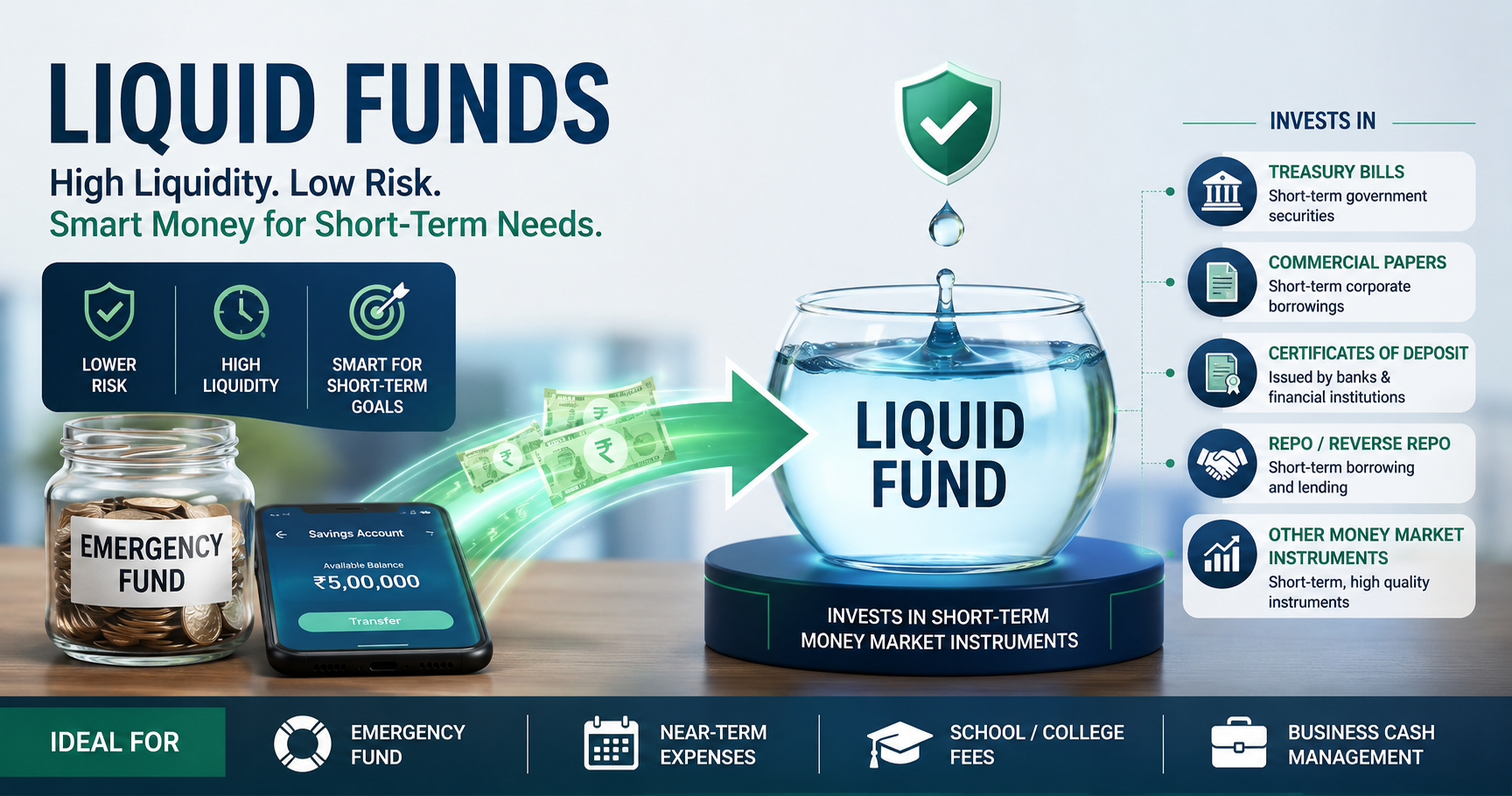
Liquid Funds: What Are They, What Are the Risks and When Should You Use Them?
Category: Financial Assets / Mutual Funds
Topic: Liquid Funds
Speaker: P.C. Balasingh
Original Publisher: ET Tamil
Original Video: Liquid Funds-ல் Risk இருக்கா? வெறும் 2 நிமிடத்தில் பணம் கிடைக்கும்!!! | EXPLAINED
Short Answer
A Liquid Fund is a type of mutual fund that invests in very short-term debt and money-market securities.
Liquid Funds are designed for investors who may need high liquidity with relatively low interest-rate risk, rather than for investors looking purely for maximum returns.
They may be considered for purposes such as:
Emergency reserves
Near-term expenses
Annual expenses
Temporary parking of surplus cash
Certain short-term business cash requirements
However, a Liquid Fund is not a guaranteed-return product and is not completely risk-free.
The most important principle is:
The investment should match the purpose, time horizon, liquidity requirement and risk profile of the money.
Why Do Liquid Funds Matter?
When people think about investments, they often focus on one question:
"How much return will I get?"
But return is only one part of financial planning.
Money that is needed tomorrow has a very different purpose from money that is being invested for retirement 20 years from now.
The liquidity of an asset is also important.
For example, land or a house may take considerable time to convert into cash, while money in a savings account can generally be accessed much more quickly.
Therefore, a good financial strategy considers:
Purpose of the money
Time horizon
Liquidity requirement
Risk
Expected return
Future cash-flow requirement
What Is a Liquid Fund?
A Liquid Fund is an open-ended mutual fund scheme that invests in debt and money-market securities with maturity of up to 91 calendar days, according to SEBI's current mutual-fund classification.
The video discusses money-market instruments such as:
Treasury Bills
Commercial Papers
Certificates of Deposit
Repo and Reverse Repo transactions
Other short-term money-market instruments
These instruments have short maturities and are intended for short-term borrowing, lending and cash-management requirements.
Why Use a Liquid Fund Instead of Buying Money-Market Instruments Directly?
Some money-market instruments can be accessed directly by investors, but doing so may require greater knowledge of the market, appropriate access and minimum investment amounts.
A Liquid Fund provides a professionally managed pooled structure through which an investor can obtain exposure to short-term debt and money-market securities.
The video therefore discusses Liquid Funds as a convenient way for individual investors to participate in the money market without directly managing each underlying instrument.
Are Liquid Funds Risk-Free?
No.
This is an important distinction.
Liquid Funds are designed to have relatively low interest-rate risk because their underlying securities are very short term. However, they remain market-linked mutual fund investments and their returns are neither fixed nor guaranteed.
SEBI scheme documentation describes Liquid Funds in terms of relatively low interest-rate risk and credit risk that can still exist.
1. Credit Risk
The issuer or counterparty of a debt or money-market instrument may fail to meet its obligations.
The original video specifically explains that credit/default risk exists even in money-market instruments, although the level of risk can differ depending on the securities held.
2. Interest-Rate Risk
Changes in interest rates can affect the value of debt securities.
Because Liquid Funds invest in very short-maturity securities, their interest-rate sensitivity is generally much lower than that of longer-duration debt funds.
3. Liquidity and Market Risk
The underlying securities are intended to be highly liquid, but market conditions can still affect the ability to transact efficiently.
Therefore:
Relatively low risk does not mean zero risk.
When Can a Liquid Fund Be Useful?
1. Emergency Fund
An emergency fund exists for an unexpected financial requirement.
Its primary purpose is not maximum return.
Its primary purpose is:
Availability + stability + accessibility.
The video discusses why emergency money should not simply be placed in assets whose value can fluctuate significantly when the money may suddenly be required.
A Liquid Fund can be considered as one possible component of an emergency-fund strategy, depending on the investor's circumstances and liquidity requirements.
2. Annual and Near-Term Expenses
Many families know that certain expenses will arise during the year:
School fees
Insurance premiums
Annual taxes
Planned payments
Other predictable expenses
If the money is required in the near term, exposing it unnecessarily to high market volatility may create a mismatch between the investment and the purpose.
The video uses school fees as an example of money that may be required within a relatively short period.
The key question is:
When will I need this money?
3. Business Operating Cash
Businesses frequently have cash that sits temporarily between receiving revenue and making payments.
For example:
Customer receipts → Cash available → Salaries / rent / suppliers / operating expenses
The video discusses the possibility of using Liquid Funds for appropriate temporary operating cash instead of allowing surplus cash to remain completely idle in a current account.
The suitability of such an approach depends on the business's actual cash-flow cycle and immediate liquidity requirements.
Why Isn't the Highest Return Always the Best Return?
One of the central messages of the video is that maximum return should not be the only objective of an investment strategy.
Consider two types of money:
Money required next month
and
Money required after 20 years
They should not necessarily be invested in the same way.
A higher-return investment may involve higher volatility or greater risk.
A lower-return investment may be more appropriate when the primary requirement is liquidity and capital stability.
Therefore, investment decisions should consider:
Purpose + Time Horizon + Liquidity + Risk + Return
A Simple Example
Suppose an individual has money that is expected to be required over the next year.
If that money is invested entirely in a volatile asset and the market falls just before the money is needed, the investor may be forced to sell at an unfavourable time.
Instead, the investor may evaluate an appropriate short-term investment option based on the required liquidity, risk tolerance and time horizon.
A Liquid Fund may be one such option.
The objective is not to find the investment with the highest possible return.
The objective is to find an investment that is appropriate for the job the money needs to perform.
The RxT Perspective
At RxT, we believe that:
The product should follow the financial need — not the other way around.
Before asking:
"Which mutual fund should I buy?"
ask:
"What is this money supposed to do?"
Money intended for:
Emergency needs
Near-term expenses
Business operations
Children's education
Retirement
Long-term wealth creation
may require different investment strategies.
Therefore, a Liquid Fund should not automatically be recommended to every investor.
The important question is:
How much of this person's money needs liquidity and relative stability, and for how long?
This is part of a broader financial-health approach where financial goals, cash flows, risk profile and behaviour are considered before selecting a financial product.
Key Takeaways
Liquidity and return are different characteristics of an investment.
Liquid Funds invest in very short-term debt and money-market securities.
Under SEBI's current classification, Liquid Funds invest in securities with maturity of up to 91 calendar days.
Liquid Funds are designed for high liquidity and relatively low interest-rate risk.
They are not risk-free or guaranteed-return investments.
Credit risk and other market-related risks can still exist.
Liquid Funds may be considered for appropriate emergency reserves and near-term financial requirements.
Businesses may also evaluate them for suitable temporary operating cash.
The highest-return investment is not necessarily the best investment for every financial goal.
Investment selection should begin with the purpose, time horizon and liquidity requirement of the money.
Frequently Asked Questions
What is a Liquid Fund?
A Liquid Fund is an open-ended mutual fund scheme investing in debt and money-market securities with maturity of up to 91 calendar days.
Are Liquid Funds completely safe?
No investment should be described as completely risk-free. Liquid Funds are relatively low-risk compared with many other market-linked investments, but their returns are not guaranteed and risks remain.
Can I use a Liquid Fund for my emergency fund?
A Liquid Fund can be considered as part of an emergency-fund strategy, depending on your financial circumstances, liquidity requirements and risk profile.
Is a Liquid Fund the same as a savings account?
No. A savings account is a bank deposit designed for banking and transactional needs. A Liquid Fund is a market-linked mutual fund investment.
Can businesses use Liquid Funds?
Businesses can evaluate Liquid Funds for appropriate temporary surplus or operating cash, provided the investment is consistent with their cash-flow requirements.
Is a higher-return investment always better?
No. The appropriate investment depends on the purpose, time horizon, liquidity requirement and risk profile of the money.
Original Video
Liquid Funds-ல் Risk இருக்கா? வெறும் 2 நிமிடத்தில் பணம் கிடைக்கும்!!! | EXPLAINED
Speaker: P.C. Balasingh
Publisher: ET Tamil
Watch the original video:
https://www.youtube.com/watch?v=m8wqX8a130Y
This article has been prepared from the original video discussion to make the financial concepts easier to read, search and reference.
Editorial Note
This article is based on the original video discussion and has been structured for easier reading and reference. Statements in the original video relating to returns, market conditions or other time-sensitive information should not be treated as current rates or guarantees.
Financial products involve risk. Investors should evaluate their financial objectives, liquidity requirements, time horizon and risk profile before making investment decisions.
This article is for educational purposes and does not constitute personalised investment advice.