
Asset Allocation: Why Investing Alone Won't Make You Wealthy
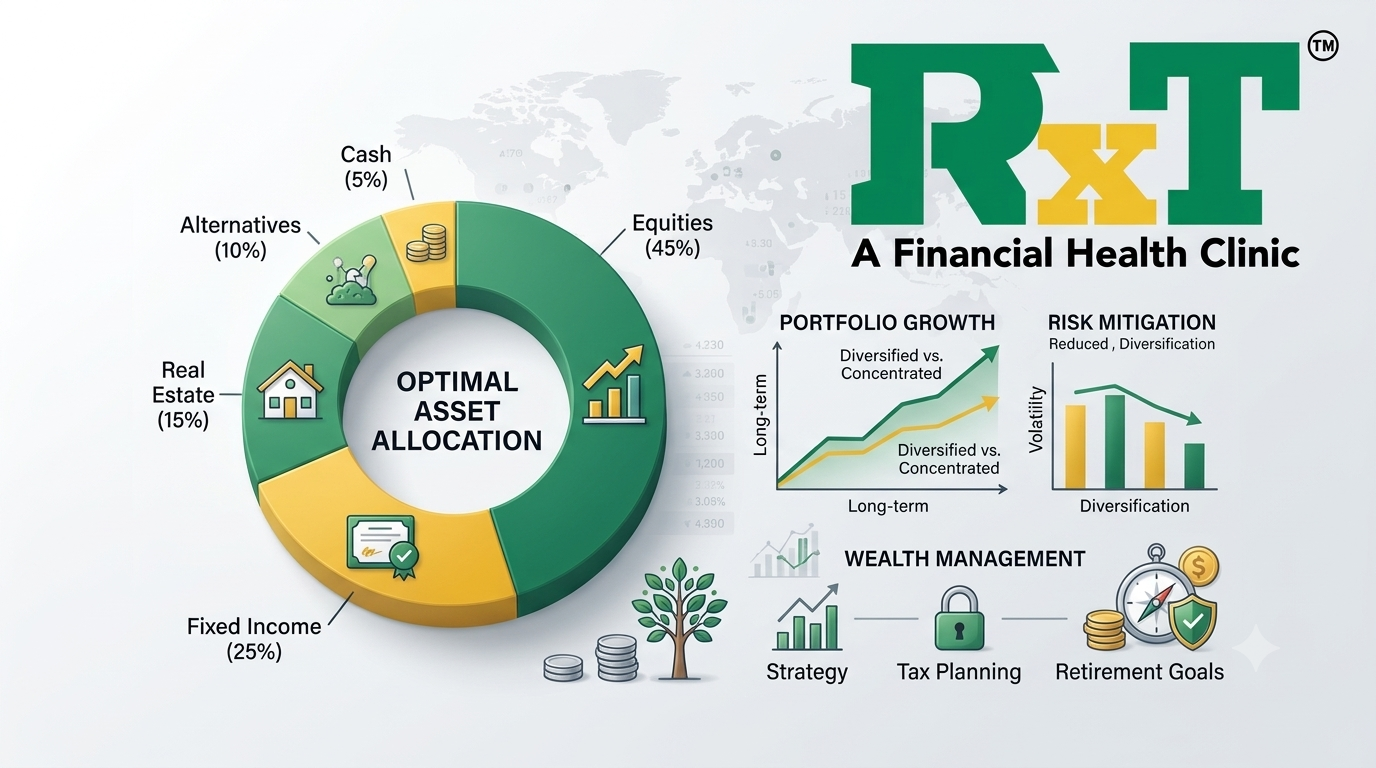
Asset Allocation: Why Investing Alone Won't Make You Wealthy
The importance of portfolio diversification, risk management and goal-based investment planning
Many people believe that investing in the stock market is the fastest way to build wealth. When equity markets perform well, investors often increase their exposure to stocks, reduce their debt investments and sometimes ignore other asset classes altogether.
Similarly, when gold prices rise, many rush to buy gold. When real estate becomes popular, investors look for property opportunities.
But is chasing the best-performing asset really the smartest way to build long-term wealth?
Not necessarily. The secret to sustainable wealth creation is not simply how much you invest or which investment performs best. It is how intelligently you allocate your money across different asset classes.
At RxT – A Financial Health Clinic, we believe that asset allocation is one of the most important foundations of sound financial planning.
This article explores the principles of asset allocation, portfolio diversification, investment discipline and goal-based financial planning, based on an expert discussion originally featured on ET Tamil.
1. What Is Asset Allocation and Why Does It Matter?
Asset allocation is the process of dividing your investment portfolio among different asset classes based on your financial goals, investment horizon and ability to take risks.
Common asset classes include:
Equity: Stocks and equity mutual funds that offer long-term growth potential but involve market volatility.
Debt: Fixed deposits, bonds, debt mutual funds and other fixed-income instruments that serve different income and stability needs.
Gold: A traditional asset that can provide diversification and exposure to precious metals.
Real Estate: Physical property and Real Estate Investment Trusts (REITs).
International Investments: Funds that provide exposure to global financial markets.
Alternative Assets: Other investment categories, including emerging asset classes such as cryptocurrencies, which carry distinct risks.
The objective is not to find one investment that performs exceptionally well every year. It is to construct a portfolio in which different investments serve different purposes.
An investor who puts all their money into equities may experience significant losses during a market correction. Someone who invests everything in debt may struggle to achieve sufficient long-term growth or outpace inflation.
A diversified portfolio helps avoid excessive dependence on a single asset class.
2. Why Investing Everything in Equity Can Be a Mistake
The growing popularity of the stock market, particularly among younger investors, has encouraged many people to believe that equity is the only asset class worth investing in.
The strong market performance following the COVID-19 market crash introduced many new investors to equities. Some investors experienced substantial gains, particularly in small-cap and mid-cap stocks.
However, a period of strong returns can create overconfidence.
Investors may start asking:
Why should I invest in debt when equity offers higher returns?
Why should I hold gold when stocks are performing well?
Why should I diversify when one asset class is generating better returns?
This mindset can become dangerous.
When valuations become expensive, the margin of safety may shrink. A significant market correction can affect investors who have concentrated too much of their wealth in equities.
Imagine an investor whose portfolio is heavily invested in stocks. If the equity market falls by 30–40%, the resulting loss may cause emotional stress and undermine their confidence in investing.
The investor may then sell at the wrong time, turning a temporary market decline into a permanent financial setback.
The important lesson: Do not confuse a rising market with a risk-free investment opportunity.
The right question is not simply which investment offers the highest return. It is whether your overall portfolio can withstand different market conditions.
3. Is the Traditional 60:40 Portfolio Still Relevant?
Traditionally, investors have used combinations of equity and debt to balance growth and stability.
One commonly discussed approach is the 60:40 portfolio, which allocates:
60% to equity
40% to debt
However, financial markets and economic conditions continue to evolve.
Geopolitical developments, inflation, interest-rate changes and global economic uncertainty can influence how different asset classes perform.
There are also more investment opportunities available today, including REITs and international mutual funds.
This does not mean traditional asset allocation principles should be abandoned.
Instead, investors can consider incorporating additional asset classes while maintaining a stable foundation.
For example, an illustrative diversified allocation discussed in the interview is:
Asset Class | Illustrative Allocation |
|---|---|
Equity | 50% |
Debt | 30% |
Gold | 10% |
Real Estate | 10% |
Total | 100% |
This is an example to explain diversification, not a universal recommendation.
The appropriate allocation depends on the investor's age, financial goals, investment horizon, income stability and risk tolerance.
4. The Core-Satellite Approach: Balancing Stability and Opportunities
One useful concept discussed in the interview is the core-satellite approach to asset allocation.
It separates a portfolio into two broad components.
The Core Portfolio – 80%
The core portion represents the foundation of the investment portfolio.
It is intended to maintain a relatively stable, goal-oriented allocation across essential asset classes such as equity and debt.
The core portfolio should be designed according to the investor's financial goals and risk capacity.
The Satellite Portfolio – 20%
The remaining portion can be used for tactical allocation.
Depending on the investor's knowledge, experience and market understanding, this portion may be allocated to:
Gold or silver
REITs
International funds
Other suitable asset classes
Multi-asset or dynamic asset allocation strategies
The purpose is to allow some flexibility without disturbing the core investment plan.
For investors who cannot regularly monitor market conditions or identify opportunities, professionally managed multi-asset or dynamic asset allocation funds may be worth evaluating.
These funds may adjust exposure across different asset classes according to their investment mandate and management strategy. Investors should examine the fund's methodology, costs and risks before investing.
The key principle is to maintain discipline in the core portfolio while allowing controlled flexibility in the satellite portfolio.
5. Asset Allocation Must Depend on Your Financial Goals
There is no single asset allocation that is suitable for everyone.
A person's investment strategy should reflect when the money will be needed.
Short-Term Goals: 3–5 Years
Examples include:
Purchasing a car
Making a house down payment
Funding an upcoming education expense
Meeting other planned financial commitments
When the investment horizon is short, protecting the required capital and maintaining liquidity become particularly important.
The discussion suggests keeping equity exposure relatively low, potentially around 10–20%, with a larger allocation to suitable debt investments.
This is because equity markets can experience significant volatility over short periods. A market decline just before the money is needed could disrupt the goal.
Long-Term Goals: More Than 5–7 Years
Examples include:
Retirement planning
Children's higher education
Long-term wealth creation
Building financial independence
Longer investment horizons may provide greater flexibility to include growth-oriented assets such as equity.
Investors can also consider diversified exposure to gold, REITs and international investments, depending on their circumstances.
A core-satellite strategy may be considered for these longer-term objectives.
The important distinction is that short-term money should not be exposed to unnecessary volatility simply in pursuit of higher returns.
6. Avoid Emotional Investing: Don't Chase Every Rising Asset
Human behaviour plays a major role in financial decision-making.
When gold prices rise, investors fear missing out and rush to purchase gold.
When equity markets perform well, investors want to increase their stock market exposure.
When a particular investment becomes popular, many people invest without evaluating whether it fits their existing portfolio.
This is a classic example of emotionally driven investing.
Even investors who understand financial concepts can make poor decisions when fear, greed and excitement influence their choices.
A disciplined investor should:
Define financial goals before selecting investments.
Establish a suitable asset allocation.
Write down an investment plan.
Decide how much to allocate to each asset class.
Avoid changing the plan merely because an asset's price has increased.
Review the portfolio periodically.
Rebalance when allocations move significantly away from the target.
An Investment Policy Statement (IPS) can help investors document their objectives, asset allocation, risk limits and rebalancing rules.
Having a written investment policy makes it easier to remain disciplined during periods of market volatility.
7. How to Rebalance Your Investment Portfolio
Asset allocation is not something you decide once and forget.
Over time, different investments generate different returns. Consequently, your original allocation can change.
Consider this example:
You initially allocate:
60% to equity
40% to debt
After a strong equity market rally, the portfolio changes to:
65% equity
35% debt
Your equity exposure has increased beyond the original target.
Portfolio rebalancing involves bringing the allocation closer to the intended proportions.
This may involve reducing some equity exposure and reallocating the proceeds to debt or other underweighted assets.
There are two commonly discussed approaches.
A. Annual Rebalancing
Review the portfolio once a year.
Evaluate the performance of investments, compare them with appropriate benchmarks and check whether the portfolio remains aligned with your financial objectives.
B. Threshold-Based Rebalancing
Instead of waiting for an annual review, establish a predetermined allocation range.
For example, if your target equity allocation is 60%, you might review the portfolio when equity exposure moves beyond 65%.
A deviation of around five percentage points can serve as an illustrative review threshold.
The precise threshold should be established according to the investor's plan, transaction costs and tax implications.
Rebalancing is not about predicting market movements. It is about maintaining the intended level of risk.
8. Physical Gold vs Gold ETFs and Gold Mutual Funds
Gold has traditionally been an important part of Indian household wealth.
However, there is an important distinction between buying gold for personal use and investing in gold for financial purposes.
Physical Gold
Jewellery has personal, cultural and emotional value.
However, jewellery purchases may involve:
Making charges
Wastage charges
GST
Storage and security concerns
Resale-related considerations
If you need jewellery for personal or family use, purchasing physical gold may serve that purpose.
Gold ETFs and Gold Funds
For investment purposes, investors can evaluate financial instruments such as Gold ETFs and Gold Mutual Funds.
These provide exposure to gold prices without requiring investors to purchase and store physical jewellery.
The appropriate instrument depends on costs, liquidity, product structure, taxation and the investor's circumstances.
The discussion also highlights an important point: there is no need to convert all existing physical assets into digital investments.
Existing property, jewellery and other assets may continue serving their intended purposes. Future investment decisions can be made using suitable financial instruments.
9. REITs: Getting Real Estate Exposure Without Buying an Entire Property
Real estate is another important asset class.
However, purchasing a residential or commercial property generally requires a substantial investment.
Not everyone can afford to purchase multiple properties and maintain them for rental income.
Real Estate Investment Trusts (REITs) provide another way to obtain exposure to income-generating real estate.
REITs allow investors to participate in eligible real estate portfolios through market-traded units, subject to the structure of the particular REIT.
Potential benefits include:
Access to real estate exposure with a comparatively smaller investment.
Participation in income generated by underlying properties.
Greater accessibility than directly purchasing an entire property.
An additional asset category for portfolio diversification.
However, REITs are not risk-free. Their market prices, distributions, occupancy levels, interest-rate sensitivity and underlying property performance can fluctuate.
Investors should understand these risks before investing.
10. Should Young Investors Prefer Digital Investments Over Physical Assets?
Young professionals who have recently started earning often have limited savings.
They may not have sufficient capital to purchase physical property or substantial quantities of gold.
The discussion suggests distinguishing between consumption needs and investment needs.
For example:
If you need jewellery for personal or family use, physical gold may be appropriate.
If your objective is financial exposure to gold, Gold ETFs or Gold Mutual Funds may be worth evaluating.
If you want real estate exposure without purchasing an entire property, you can study REITs.
For young investors, the first priority should be establishing a sound financial foundation.
This includes building emergency savings, managing short-term financial obligations, planning for future goals and developing a disciplined investment habit.
Digital investment products can provide access to different asset classes, but investors should understand the underlying risks rather than choosing products simply because they are convenient or popular.
11. Your Financial Goals Can Change. Your Asset Allocation Should Change Too.
Financial goals are not permanent.
A person who initially plans to retire at 60 may later decide to retire at 50.
Someone planning to purchase a car in five years may decide to buy it next year.
A family initially planning for one child's education may later need to plan for two children.
Other goals may include:
Purchasing a house
Supporting parents
Funding overseas education
Starting a business
Early retirement
Creating regular retirement income
Whenever financial goals change, the investment plan may need to change as well.
Consider an individual who originally plans to retire at 58 but later decides to retire at 50.
The earlier retirement creates a longer period during which the individual must fund living expenses without employment income.
This changes the portfolio requirements.
The investor may need:
Greater liquidity
A more carefully planned debt allocation
Sufficient investments for regular cash flow
A strategy to reduce dependence on equity during the initial retirement years
For this reason, financial goals should be reviewed at least annually and whenever a significant life event occurs.
12. Why Liquidity Becomes Important Before Retirement
A common mistake is to maintain excessive equity exposure close to retirement.
Imagine someone who is planning to retire soon, but most of their investments remain in equities.
If the stock market falls significantly just before retirement, they may be forced to sell investments at unfavourable prices to meet their immediate expenses.
This is particularly important because retirement can last several decades.
A better approach is to plan liquidity requirements in advance.
For example, an investor approaching retirement may gradually move an appropriate portion of their portfolio into suitable debt or other liquid instruments to meet expenses over the coming years.
The exact allocation depends on retirement age, expected expenses, other income sources, existing assets and risk capacity.
Retirement planning is not simply about accumulating a large corpus. It is also about ensuring that the money is available when required.
13. How Often Should You Review Your Asset Allocation?
Even if your financial goals have not changed, your portfolio deserves periodic attention.
An annual review can help you understand:
Whether the portfolio is performing in line with its objectives.
Whether investments are meeting reasonable benchmarks.
Whether equity exposure has increased or decreased significantly.
Whether debt and other asset allocations remain appropriate.
Whether the portfolio needs rebalancing.
Whether your risk exposure is still suitable.
An annual review should not automatically result in buying and selling investments.
Sometimes, maintaining the existing allocation is the correct decision.
The objective is to identify meaningful deviations and make adjustments only when justified.
14. What Happens If You Get Asset Allocation Wrong?
An investor may choose good mutual funds, invest regularly and save consistently, but still experience poor portfolio outcomes because of inappropriate asset allocation.
Consider two situations.
Situation A: Excessive Equity Exposure
An investor approaching retirement keeps almost all their investments in equity.
A major market correction occurs just before retirement.
The investor may be forced to withdraw money during an unfavourable market period.
Situation B: Excessive Debt Exposure
Another investor keeps nearly all their long-term investments in debt instruments.
Although the portfolio may experience less market volatility, its growth may be insufficient to meet long-term financial objectives, particularly after considering inflation.
Both situations illustrate why asset allocation matters.
A portfolio should balance growth, stability, liquidity and risk according to the investor's requirements.
It is not enough to invest. You must invest appropriately.
15. Practical Steps to Build a Better Asset Allocation Strategy
Here is a simple framework investors can follow.
Step 1: Understand Your Current Financial Position
List your income, expenses, savings, investments, loans and insurance coverage.
Step 2: Define Your Financial Goals
Separate your goals into short-term, medium-term and long-term categories.
Step 3: Identify Your Investment Horizon
Determine when you will need the money for each goal.
Step 4: Assess Your Risk Capacity and Risk Tolerance
Understand both your financial ability to absorb losses and your emotional ability to withstand market volatility.
Step 5: Establish Your Asset Allocation
Decide how much should be allocated to equity, debt, gold, real estate and other suitable investments.
Step 6: Invest Consistently
Use a disciplined investment approach, such as regular monthly investments where appropriate.
Step 7: Review and Rebalance
Review your portfolio annually and whenever your financial goals or circumstances change significantly.
Step 8: Avoid Emotional Decisions
Do not change your investment strategy merely because an asset class is performing exceptionally well or poorly.
Frequently Asked Questions About Asset Allocation
1. What is asset allocation in financial planning?
Asset allocation is the process of distributing investments across different asset classes, such as equity, debt, gold, real estate and international investments. It helps align a portfolio with an investor's financial goals, investment horizon and risk capacity.
2. Why is asset allocation more important than selecting individual mutual funds?
Selecting a good mutual fund is important, but the overall portfolio structure determines how much exposure an investor has to different risks. Even good funds can create an unsuitable portfolio if too much money is concentrated in one asset class.
3. What is the ideal asset allocation for an investor?
There is no universally ideal asset allocation. It depends on age, financial goals, investment horizon, income stability, liquidity requirements and risk tolerance. A strategy suitable for a 25-year-old investing for retirement may not be appropriate for someone retiring in three years.
4. Is a 60:40 equity-debt portfolio still relevant?
A 60:40 portfolio remains a commonly discussed allocation framework. However, it is not suitable for every investor. Some portfolios may benefit from additional exposure to gold, REITs or international investments, depending on individual requirements.
5. What is the core-satellite investment strategy?
The core-satellite strategy divides a portfolio into a core component designed for long-term objectives and a smaller satellite component that allows controlled tactical exposure to other investment opportunities.
An illustrative structure discussed in the interview is 80% core and 20% satellite.
6. How much gold should I hold in my investment portfolio?
The appropriate allocation depends on your financial situation and existing exposure. A 10% allocation is used as an illustrative example in the discussion, not as a universal rule. Investors should consider both physical gold and financial gold investments when evaluating total exposure.
7. Should I invest in Gold ETFs instead of buying jewellery?
Jewellery serves personal and consumption needs, whereas Gold ETFs and Gold Mutual Funds are financial instruments intended to provide investment exposure to gold. The appropriate choice depends on the purpose of the purchase, costs and investment requirements.
8. What is portfolio rebalancing?
Portfolio rebalancing is the process of adjusting investments to bring the actual asset allocation closer to the original target allocation. It helps maintain the intended portfolio risk.
9. How frequently should I rebalance my portfolio?
An annual review is a practical starting point. Investors can also use predetermined allocation thresholds, such as a deviation of five percentage points, to trigger a review.
10. Should short-term goals be invested in equity?
Short-term goals generally require greater attention to capital preservation and liquidity. Equity exposure should be carefully evaluated because market volatility can affect the availability of funds when they are needed.
11. Does asset allocation need to change when financial goals change?
Yes. Changes in retirement plans, family responsibilities, education expenses and other financial commitments can affect investment horizons and liquidity needs. The portfolio should be reviewed and adjusted accordingly.
12. Can diversified asset allocation eliminate investment risk?
No. Diversification can help reduce concentration risk, but it cannot eliminate all investment risks. Different asset classes can decline simultaneously, and investors can still experience losses.
Conclusion: Stop Chasing Returns. Start Managing Your Financial Health.
Wealth creation is not about finding one investment that delivers extraordinary returns.
It is about building a financial plan that can withstand different market conditions, accommodate changing life goals and support your long-term financial well-being.
Equity may offer growth potential. Debt may provide stability and income. Gold may offer diversification. Real estate and international investments may provide additional exposure to different markets.
Each asset class has a purpose, and each comes with its own risks.
The real challenge is determining how much of your money should go into each investment and when that allocation should change.
Remember these three principles:
Asset allocation matters more than chasing the latest popular investment.
Your investment strategy should be based on your financial goals, not market excitement.
Regular portfolio reviews and disciplined rebalancing help keep your investments aligned with your financial future.
At RxT – A Financial Health Clinic, our philosophy is simple:
Diagnosis Before Prescription.
Understand your financial health first. Define your goals. Evaluate your investments. Then build an allocation strategy that supports the life you want to live.
Because investing is only one part of wealth creation. Managing your money wisely is what makes the difference.
About RxT – A Financial Health Clinic
RxT is a financial wellness platform focused on helping individuals and businesses make informed financial decisions through financial education, financial planning and personalised financial guidance.
Our approach considers the complete financial picture, including income, expenses, savings, investments, liabilities, insurance, taxation and life goals.
We believe financial health begins with understanding your financial situation before choosing financial products or investment strategies.
Learn more: https://www.rxt.app/
Explore financial planning and portfolio guidance: https://www.rxt.app/
Watch the Original Discussion
This article is based on the discussion titled:
"முதலீடு செய்தால் மட்டும் கோடீஸ்வரர் ஆக முடியாது... Asset Allocation ரொம்ப முக்கியம்!!"
Originally featured on ET Tamil.
Watch the full discussion here
Financial Disclaimer
This article is intended solely for financial education and general informational purposes. It does not constitute personalised investment advice, a recommendation to buy or sell any financial product, or a guarantee of investment returns.
The asset allocation percentages and examples are illustrative and should not be treated as recommendations for every investor. All investments involve risks, including possible loss of capital. Equity, debt, gold, REITs, international funds and alternative investments have different risk characteristics.
Investors should evaluate their financial circumstances, investment objectives, time horizon, liquidity requirements and risk capacity before making investment decisions. Consider consulting a qualified financial professional for personalised guidance.
Editorial note: This article is based on an expert discussion and has been organised into an educational format for readers. Market conditions and investment products may change over time.