One Lakh Postmen to Become Mutual Fund Distributors: A New Opportunity for Financial Inclusion or a Risk for Small Investors?
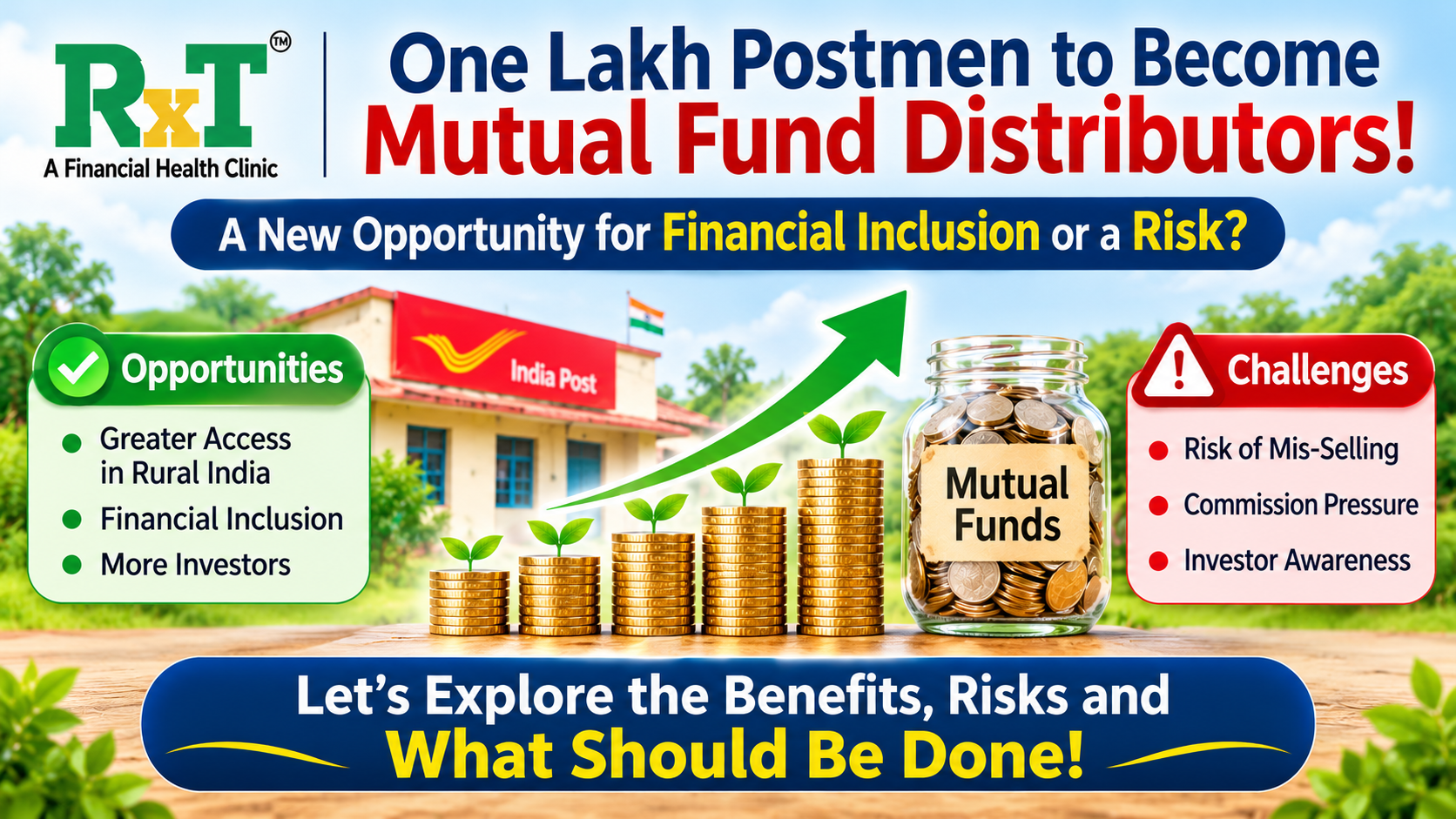
One Lakh Postmen to Become Mutual Fund Distributors: A New Opportunity for Financial Inclusion or a Risk for Small Investors?
How India's postal network could expand mutual fund access to rural communities, and why investor education, ethical distribution and regulatory safeguards will be critical to its success.
Category: Mutual Funds | Financial Literacy | Personal Finance | Investment Awareness
Introduction
India's mutual fund industry is preparing for a potentially significant expansion of its distribution network through the postal department. A proposal to train approximately one lakh postmen as mutual fund distributors could bring investment products to rural communities and locations that traditional financial distribution channels have not adequately reached.
At first glance, this appears to be a promising initiative. India has an extensive postal network, including branches in remote villages. Postmen already enjoy considerable public trust because of their long-standing relationships with local communities.
However, an important question deserves attention: Can the postal network successfully distribute mutual funds without exposing financially inexperienced investors to unsuitable investment products?
The initiative offers considerable opportunities, but it also raises concerns about financial literacy, product suitability, commission-driven selling and the responsibilities of newly trained distributors.
This article examines the opportunities and challenges discussed in an ET Tamil interview, featuring an expert's analysis of the proposed initiative.
1. Why Does India Need More Mutual Fund Distributors?
India has a relatively low level of mutual fund participation compared with several developed markets.
The discussion highlights that approximately five crore unique investors participate in India's mutual fund industry, representing a relatively small proportion of the country's population. It contrasts this with the much higher participation in mutual funds and equity markets in the United States.
This gap indicates that a large section of India's population has not yet become familiar with market-linked investment opportunities.
Several factors contribute to this situation:
Limited financial awareness in rural communities.
Lack of access to qualified financial distributors and advisors.
Preference for traditional savings products.
Fear of losing money in stock market-related investments.
Limited understanding of mutual funds and market risks.
Increasing the number of distributors and expanding access to financial products can help address some of these challenges.
The proposal to train one lakh postal employees as mutual fund distributors could therefore become an important step towards improving financial inclusion.
2. How Could the One Lakh Postmen Initiative Work?
According to the discussion, the initial phase involves selecting approximately one lakh postmen from four northeastern states and providing them with training to become mutual fund distributors.
The postal department already has a well-established presence in rural and remote locations. By using this existing network, mutual fund companies could potentially reach communities that are not adequately served by conventional distribution channels.
The initiative could create benefits for multiple stakeholders:
Investors: Greater access to mutual fund products.
Postal employees: An opportunity to earn additional income.
India Post: An opportunity to expand its financial services.
Mutual fund companies: Access to a wider distribution network.
The financial industry: Increased awareness and participation in capital markets.
The expert considers the initiative positive in principle because expanding access to financial products is important for India's financial development.
However, successful distribution requires much more than geographical reach.
3. What Qualifications Are Required to Become a Mutual Fund Distributor?
An important aspect of the discussion is the qualification required to become a mutual fund distributor.
The interview explains that a person generally needs to complete the prescribed mutual fund distributor certification examination, referred to in the discussion as the Series V-A examination.
The discussion also highlights that a minimum educational qualification of Class 12 is sufficient to pursue the certification.
This suggests that becoming a mutual fund distributor does not necessarily require a highly advanced academic qualification.
However, passing an examination and possessing practical financial knowledge are two different things.
A distributor should understand:
Different categories of mutual funds.
Equity, debt and hybrid mutual funds.
Investment risks and market volatility.
Investment horizons and liquidity requirements.
The importance of asset allocation.
The relationship between risk and expected returns.
The importance of matching investments with individual financial goals.
A certification can establish a minimum level of knowledge, but continuous learning and ethical conduct are equally important.
4. Understanding How Mutual Fund Distributors Earn Commissions
To understand the potential challenges of this initiative, it is important to understand how the mutual fund distribution ecosystem works.
Asset Management Companies (AMCs) launch and manage mutual fund schemes. They distribute their products through various channels, including banks, financial distributors and independent mutual fund distributors.
Distributors may receive commissions for bringing investors into mutual fund schemes and servicing their investments.
The commission structure can vary depending on the scheme, distribution arrangement and applicable regulatory framework.
For distributors, commissions are an important source of livelihood.
However, this creates a potential conflict of interest.
When a distributor earns income from selling financial products, there may be an incentive to recommend products based on commercial considerations rather than the investor's actual needs.
This does not mean that every distributor acts unethically. Many distributors work responsibly and place their clients' interests first.
Nevertheless, the distribution model must include appropriate safeguards to prevent commission incentives from influencing investment recommendations.
This concern becomes particularly important when a large number of new distributors enter the market simultaneously.
5. The Biggest Concern: Public Trust Can Become a Double-Edged Sword
One of the most important observations in the interview concerns the trust people place in postmen.
In rural India, postmen are often more than employees delivering letters. They are familiar faces who regularly interact with families and local communities.
People trust them because of their long-standing relationship with the postal department.
This trust can make them effective financial distribution partners.
However, it can also create risks.
The interview draws a comparison with banks that distribute insurance and investment products. Customers often purchase financial products because they trust their banks, without fully understanding the product's features, costs or risks.
The expert raises concerns that similar problems could emerge when postal employees begin distributing mutual funds.
Consider a hypothetical situation:
A postman visits a rural household and recommends a particular mutual fund, explaining that it has the potential to generate attractive returns.
The family trusts the postman and invests its savings.
However, if the stock market subsequently falls by 20% or 30%, the investment value could decline significantly.
For an investor who does not understand market-linked investments, this could result in considerable financial distress.
The problem is not necessarily the mutual fund itself. The problem is whether the investor understood the risk before investing.
Trust should help people access financial services, not become a substitute for financial knowledge.
6. Mutual Funds Are Not the Same as Traditional Postal Savings Products
The interview makes an important distinction between traditional postal savings schemes and mutual funds.
India's postal network has historically played an important role in encouraging savings through products such as recurring deposits.
These products have helped develop a savings habit among people, particularly in rural areas.
A postal employee or agent collecting a small amount regularly can encourage individuals to save even when they do not have substantial disposable income.
This approach has helped bring many people into the formal savings system.
However, mutual funds operate differently.
Consider the difference:
Traditional recurring deposits | Mutual funds |
|---|---|
Offer a predetermined interest structure | Returns depend on the underlying investments |
Generally provide greater predictability | Market-linked schemes can fluctuate in value |
Capital is not exposed to equity-market fluctuations in the same way | Capital loss is possible |
Suitable for building a disciplined savings habit | Suitability depends on risk profile and investment goals |
Do not require investors to understand stock market movements | Investors should understand market-related risks |
For example, an investor who deposits ₹100 into an equity mutual fund could see its value fall to ₹80 during a market downturn.
This possibility must be clearly explained before the investor makes a decision.
A distributor cannot simply apply the same selling approach used for traditional savings products to market-linked investments.
7. The Risk of Aggressive Sales Targets and Commission Pressure
Another major concern raised in the interview is the possibility of external pressure on distributors.
When a large organisation introduces a new distribution channel, performance targets may be established.
Distributors could be encouraged to achieve certain sales volumes through incentives, additional commissions or bonuses.
This creates a potential conflict.
Suppose a postal employee receives additional incentives for distributing particular mutual fund schemes.
The employee may feel pressure to recommend those schemes even when they are not suitable for the investor.
The problem could become more serious if employees have limited financial knowledge or experience.
The interview also highlights that existing mutual fund distributors face commercial pressures. Even experienced professionals must make conscious efforts to ensure that their recommendations remain aligned with investors' interests.
New distributors entering the industry may find it difficult to resist such pressures.
This is particularly concerning when their regular income is limited and additional commissions become financially attractive.
Therefore, the initiative should not be evaluated only by the number of distributors trained or the amount of money collected.
The quality and suitability of investments should also be measured.
8. Will One Lakh New Distributors Be Able to Provide Proper Financial Guidance?
Becoming a certified mutual fund distributor is an important starting point. However, the ability to distribute products and the ability to understand an investor's complete financial situation are not necessarily the same.
A responsible financial distribution process should consider several factors:
Financial goals: What is the investor saving for?
Investment horizon: When will the investor need the money?
Risk tolerance: How much volatility can the investor comfortably handle?
Financial capacity: Can the investor afford potential losses?
Existing investments: What other financial assets does the investor already own?
Liquidity requirements: Does the investor need access to the money in the short term?
For instance, money required for a child's education next year should not automatically be invested in an equity mutual fund simply because the distributor expects higher long-term returns from equities.
Similarly, an individual approaching retirement may have different investment requirements from a young professional with a long investment horizon.
The expert's central concern is whether newly trained distributors will have sufficient practical understanding to make responsible recommendations.
The issue is not whether postmen are capable of learning about finance. With proper education, training and experience, they can become effective distributors.
The real question is whether the training and operating environment will prepare them to handle the responsibility.
9. Will the Initiative Increase Direct Mutual Fund Investments?
The discussion also explores whether this initiative could reduce investors' dependence on distributors and encourage more people to invest directly.
The expert believes that the opposite could happen: the initiative may increase overall awareness and participation in mutual funds.
When one lakh postal employees start discussing mutual funds across villages and smaller communities, the subject could become much more familiar to ordinary people.
People who have never considered mutual funds may begin researching them.
Some may approach distributors, while others may explore direct investment platforms.
This could increase the number of people entering the mutual fund ecosystem.
However, increased participation does not automatically mean better investment decisions.
Investors who choose the direct route should also understand the products they are purchasing.
The interview makes an important recommendation: investors should not assume that online information alone is sufficient to construct a sound investment strategy.
Even individuals who prefer managing their investments independently can benefit from consulting a qualified financial professional periodically.
10. Why Should Investors Consult a Financial Professional?
One of the strongest messages from the interview is the importance of professional financial guidance.
Many investors believe that they can manage their entire financial life by researching products online.
Although online information is valuable, knowing about individual investment products is different from understanding how those products fit into a complete financial plan.
An investor might understand equity mutual funds but still make mistakes in:
Asset allocation.
Portfolio diversification.
Risk management.
Retirement planning.
Tax planning.
Goal-based investing.
Debt and equity allocation.
For example, an investor may invest in several mutual funds without realising that most of them hold similar stocks.
The investor might believe that the portfolio is diversified when it actually has significant concentration risk.
A financial professional can help examine the complete portfolio and identify such issues.
The expert recommends spending at least some time with a financial advisor periodically, even if it involves paying a professional consultation fee.
The objective should be to build an investment structure that matches the investor's financial goals rather than simply selecting popular investment products.
11. Positive and Negative Implications of the Initiative
The proposed expansion of mutual fund distribution through the postal network has both advantages and potential disadvantages.
Potential benefits | Potential challenges |
|---|---|
Greater mutual fund awareness in rural India | Inadequate financial understanding |
Access to previously underserved communities | Risk of unsuitable product recommendations |
Additional income opportunities for postal employees | Commission-driven selling |
Expansion of the mutual fund distribution network | Pressure to achieve sales targets |
Increased participation in financial markets | Investors may misunderstand market risks |
Development of financial awareness | Possibility of misuse of public trust |
The initiative's ultimate success will depend on how these challenges are addressed.
Expanding access is important, but protecting investors must remain the priority.
12. What Should Be Done to Make This Initiative Successful?
For this initiative to become a genuine financial inclusion success, several safeguards should be considered.
1. Comprehensive training
Training should go beyond examination preparation. Postal employees should understand mutual fund categories, investment risks, asset allocation, investor suitability and ethical distribution practices.
2. Continuous financial education
Financial products and regulations evolve. Distributors should receive regular training rather than depending entirely on their initial certification.
3. No inappropriate sales pressure
Performance targets and incentives should not encourage distributors to recommend unsuitable products.
4. Investor risk awareness
Investors should receive clear explanations about market volatility, possible capital losses, investment horizons and product suitability.
5. Transparent commission structures
Distributors should understand how they are compensated, and investors should have access to relevant information about distribution-related costs and arrangements.
6. Proper grievance redressal
Investors should have accessible channels to raise complaints if they receive misleading information or unsuitable recommendations.
7. Focus on investor outcomes
The success of the initiative should be measured not merely by the number of mutual fund accounts opened or investments collected, but also by investor awareness, suitability and long-term experience.
13. The Larger Question: Is This About Financial Inclusion or Distribution Expansion?
The expert raises another interesting question about the underlying objectives of the initiative.
One possible objective is to increase financial awareness and bring more Indians into the mutual fund ecosystem.
This is a legitimate and important goal.
The interview also offers a personal speculation that the initiative could be connected to the need for new distribution channels as large financial players expand their presence in the Indian market.
However, this is presented as the interviewee's personal opinion, not an established explanation of the government's intentions.
Regardless of the underlying commercial motivations, the initiative should ultimately be judged by its impact on ordinary investors.
If it helps rural families understand investments, make informed decisions and build long-term financial security, it could become a valuable development.
If it turns into a sales-driven distribution exercise without adequate investor protection, it could create problems for the very communities it intends to serve.
Conclusion: Financial Access Must Come with Financial Responsibility
Training one lakh postmen to become mutual fund distributors could represent an important development in India's financial inclusion journey.
India's postal network offers a unique advantage: its reach, familiarity and established relationships with local communities.
However, mutual funds are not ordinary savings products. Their market-linked nature means that investors can experience fluctuations and capital losses.
Therefore, expanding distribution without strengthening financial education could create unintended consequences.
The most important lesson is that financial inclusion should not be measured simply by how many people invest in mutual funds.
It should be measured by how many people understand what they are investing in, why they are investing, what risks they are taking and how those investments contribute to their financial goals.
The objective should not simply be to make every postman a mutual fund distributor. It should be to make every new mutual fund investor a financially informed investor.
At RxT – A Financial Health Clinic, we believe that investment decisions should be approached with the same care as healthcare decisions: understand the individual's financial condition, identify the needs, evaluate the risks and prescribe suitable solutions.
Because financial health is not about purchasing more financial products. It is about making the right financial decisions.
Frequently Asked Questions (FAQs)
1. What is the one lakh postmen mutual fund distributor initiative?
It is an initiative discussed in the interview under which approximately one lakh postal employees are proposed to be trained to become mutual fund distributors, initially covering four northeastern states.
2. Why are postmen being considered for mutual fund distribution?
Postmen have an established presence in rural and remote communities. Their existing relationships with local people could help mutual fund companies reach previously underserved investors.
3. What qualification is required to become a mutual fund distributor in India?
The interview refers to the relevant mutual fund distributor certification examination, Series V-A, and states that Class 12 education is sufficient to pursue the qualification. Candidates should check the current certification and registration requirements before applying.
4. Can mutual fund investors lose their capital?
Yes. Mutual funds, particularly equity-oriented schemes, are market-linked investments. Their NAVs can decline, and investors may receive less than their original investment.
5. Are mutual funds similar to post office recurring deposits?
No. Recurring deposits generally offer a predetermined interest structure, whereas mutual fund returns depend on the performance of their underlying investments. Their risks and return characteristics are different.
6. How do mutual fund distributors earn money?
Distributors may receive commissions from mutual fund companies under applicable distribution arrangements. Commission structures vary depending on the scheme and regulatory requirements.
7. Will more mutual fund distributors increase financial literacy?
They could increase awareness and access to mutual funds. However, genuine financial literacy requires investor education, risk awareness and responsible guidance, not simply more product distribution.
8. Should investors consult a financial advisor before investing?
Investors can benefit from professional guidance, particularly when making decisions involving asset allocation, retirement planning, taxation and long-term financial goals. Advice should be based on individual circumstances.
9. Are mutual funds suitable for everyone?
No single mutual fund is suitable for everyone. Suitability depends on financial goals, investment horizon, risk tolerance, financial capacity and liquidity requirements.
10. What is the biggest risk in expanding mutual fund distribution through postmen?
The biggest concern discussed in the interview is the possibility that inexperienced distributors may recommend unsuitable products under sales or commission pressure, potentially affecting investors who place considerable trust in them.
Source and Editorial Note
This article is based on the discussion in the ET Tamil YouTube interview:
Video: One Lakh Postmen Becoming Mutual Fund Distributors – Expert Analysis
The article presents the key arguments and concerns expressed by the interview participants in an independent, structured format. Statements about the proposed initiative and industry figures reflect the interview discussion and should not be interpreted as independently verified current regulatory or government announcements.
Disclaimer: This article is intended for financial education and awareness. It is not investment advice or a recommendation to buy or sell any mutual fund scheme. Investors should evaluate their financial circumstances and consult an appropriately qualified professional before making investment decisions.
RxT – A Financial Health Clinic
Diagnose your financial health. Prescribe the right financial solutions. Build a financially healthier future.